Play.
Instructions
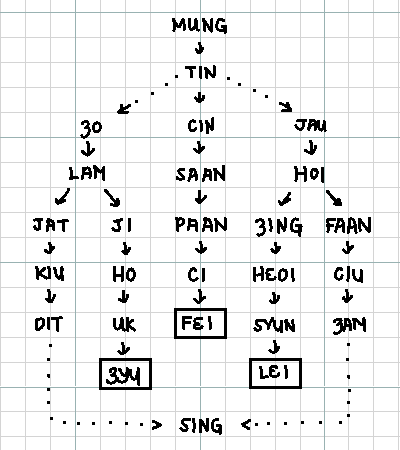
As you progress through the story, you will come across puzzles. Solve the puzzles. Take your answer and translate it into jyutping (the method of romanization for the Cantonese language). In the URL bar, replace the page's title with the translated word, i.e., https://souheilam.neocities.org/[YOUR ANSWER HERE].html. Do not include the tonal number, and remember to have the ".html" suffix, or it will not work.
Resources
Online Cantonese Dictionary to look up jyutping
Google Translate's Chinese handwriting input
Attribution & Commentary
First, for photo credits: thanks to Noah Bradley and Pexels for free-use photography, and special thanks to Flor as well, for allowing me to reference from your personal photos. Thanks to Angela for the couch photo, and to Anthony and company for hosting such a comfortable space to be in.
For puzzle inspiration, thanks to Celena for introducing me to Simon Tatham's Puzzles (or perhaps, no thanks to you, as I've probably spent too much time playing Loopy). Thank you to Zoomutt for showing me how fun puzzle hunts can be. I borrowed Zoomutt's puzzle format of inputting solutions into the URL bar in order to progress. Thanks to anna anthropy for making queers at the end of the world - you are always an inspiration.
Thanks to my mum, who taught me all I know of Cantonese.
This piece mainly works in conjunction with Wendy Hui Kyong Chun's "The Enduring Ephemeral, or the Future is a Memory." (My attempt to access this article through Professor Snelson's syllabus was rather amusing, as that link is inaccessible ... truly ephemeral. I found it again on JSTOR, as if its trying to prove its own argument.)
Conflation of memory and storage: Cantonese is a dying language. True, there are archival records of it, but as time passes, there are fewer and fewer people actually speaking it. Cantonese is primarily a spoken language, because while it shares a writing system with Mandarin, there are certain words that cannot be "translated," and thus certain characters must be specifically assigned. In addition, word choices and grammar differs between the two languages, so while Mandarin is thriving due to being China's national language, Cantonese slowly fades from existence. The people's remembrance of the Cantonese language is inequivalent to archival records.
Indeed, my own understanding of Cantonese is rather ephemeral; I feel like every time I leave home to live at college for a month and a half I forget half of the Cantonese I know because I don't have anyone to speak it with. I'm also taking Mandarin classes, and I feel that as my skill in Mandarin increases my ability to speak Cantonese deteriorates. My Cantonese isn't even that good in the first place! It's quite a dilemma.
Related, also, is the dream sequence that this piece depicts. It's a dream, which is inherently ephemeral, but it is recorded here, and thus endures as long as Neocities endures. (This is also interesting, because Neocities is a replacement site for Geocities, which was taken down by Yahoo many years prior. Nothing on the Internet is permanent!) Memory does not last, but dream journals (storage) remain ...
The Poor Image/Internet Ugly: Vaporwave, in itself, is part of The Poor Image. It can't really be considered Internet Ugly by the article's standards, but there is still a relation: it's intentionaly tacky looking! And I love it, I absolutely adore the color choices involved in vaporwave aesthetic; I love the grainy filters (even if I didn't have time to implement them into my own project) and I love the weird image edits. I bypassed the Getty watermark joke by mostly using free-use stock images, but the discussion of what gets included and tagged in a stock photo is questioned in this project. It's a question of: What do we see on the Internet? How do we make it our own?